

 Flow and boundary
Frozen record references and metadata enter; acknowledgements and results return to source.

Trace the boundaries between channels, identity, core services, events, storage and trust infrastructure.

Business applications · Five portals

WSO2 API Manager · HTTPS + OAuth2

Keycloak IAM · Token / claims

Archive · Evidence

Kafka · Outbox / Inbox

MariaDB / metadata · Object / evidence stores

TSA / RFC 3161 · CA / OCSP / CRL

Java / WildFly · Observability
Five portals, source records systems, REST clients and batch connectors. Channels do not confer business authorization.
Flow and boundaryFrozen record references and metadata enter; acknowledgements and results return to source.
| View | Layer boundary |
|---|---|
| Input / flow | User/application commands carry no inherent permission. |
| Ownership | Return authorized receipts/jobs/results; UI does not decide backend permissions. |
| Failure / recovery | Disconnect: retain idempotency key and query the original result before resubmission. |
Check tokens, scopes, environment-specific mTLS, limits and correlationId before routing.
Flow and boundaryValidated requests reach the owning service; authentication failures never become successful business jobs.
| View | Layer boundary |
|---|---|
| Input / flow | Token/mTLS, scopes and correlation; file bytes use provisioned channels. |
| Ownership | Edge authentication does not replace owning-service object authorization. |
| Failure / recovery | Timeout is not backend failure proof; diagnose TLS separately from HTTP Problem. |
GoPaperless SSO over OIDC is a target integration; LTANS separately authorizes tenants, objects and operations.
Flow and boundaryAuthenticated identity informs authorization; arbitrary body-supplied tenant values are not trusted.
| View | Layer boundary |
|---|---|
| Input / flow | Provisioned issuer/verification keys and organization mapping. |
| Ownership | Identity differs from authorization; a request tenant is not automatically authorized. |
| Failure / recovery | Reevaluate expiry/permission changes; key-source failure never authorizes unknown keys. |
Nine logical groups divide ownership; jobs track long-running work without replacing evidence state.
 Flow and boundary
Services update local transactions/outboxes, not one another’s domain stores.
| View | Layer boundary |
|---|---|
| Input / flow | Canonical commands, policy snapshots and data references. |
| Ownership | A group owns its decisions/states; no direct writes to another group’s store. |
| Failure / recovery | Define transaction/checkpoint boundaries; no assumed global rollback for external stores. |
Outbox/inbox, eventId, correlation, deduplication, bounded retry and authorized replay.
Flow and boundaryEvents carry metadata, identifiers and references; binary content uses approved storage connectors.
| View | Layer boundary |
|---|---|
| Input / flow | Local transactional outbox, envelopes and references. |
| Ownership | Separate business events from webhook attempts; no default binary payload transport. |
| Failure / recovery | Deduplicate inbox; late events reconcile current source state before irreversible effects. |
Separate metadata, originals, evidence and backups. Custody defines byte ownership and durable reread rights.
Flow and boundaryEach data class has its own access, keys and recovery criteria; digests do not replace content.
| View | Layer boundary |
|---|---|
| Input / flow | Original bytes, metadata, evidence, replicas and associated keys. |
| Ownership | Custody assigns store/key owners and reread rights; HASH_ONLY holds no originals. |
| Failure / recovery | Restore consistent recovery points and digests; bytes without keys remain unreadable. |
Deployment-profile CA/TSA, certificate paths, OCSP/CRL and HSM/KMS; validation preserves historical context.
Flow and boundaryExternal responses are checked before use; fallback never bypasses policy or status checks.
| View | Layer boundary |
|---|---|
| Input / flow | MessageImprint, tokens, certificates and status material. |
| Ownership | Network/CA/TSA sources are profiled; UNKNOWN/missing material is not GOOD. |
| Failure / recovery | Fallback uses the same approved checks; rotation retains old tokens/context. |
Observe traces/jobs, renewal alerts, secrets, configuration revisions and recovery drills.
Flow and boundaryThis is a cross-cutting control plane, not just the last ingestion step; a diagram does not establish an SLA.
| View | Layer boundary |
|---|---|
| Input / flow | Traces, checkpoints, revisioned configuration and alerts. |
| Ownership | The privileged control plane cannot bypass business approvals. |
| Failure / recovery | Reopen after reconciling data/evidence/schedules/outbox; record unrecovered scope. |
| Step | Sender → receiver | Action |
|---|---|---|
| 1 | Source → API / Archive | POST /v1/archives · rights, digest, idempotency |
| 2 | API / Archive → Source | 202 · archiveId/jobId; not complete |
| 3 | API / Archive → Evidence | EvidenceGenerationRequested · outbox |
| 4 | Evidence → Storage | Read bytes under custody |
| 5 | Evidence → Trust Adapter / TSA | Timestamp for digest binding |
| 6 | Trust Adapter / TSA → Evidence | Token and validation material |
| 7 | Evidence → Storage | Store revision after validation |
| 8 | Source → API / Archive | Reconcile job and evidence state |
| Step | Sender → receiver | Action |
|---|---|---|
| 1 | Caller → API / Verification | POST /v1/archives/{archiveId}/verification |
| 2 | API / Verification → Storage | Read authorized data/revision |
| 3 | API / Verification → Trust Adapter | Time-bound paths, status and policy |
| 4 | API / Verification → Report | Step outcomes; evaluatedAt |
| 5 | Caller → API / Verification | GET /v1/jobs/{jobId} |
| 6 | Caller → Report | GET /v1/verifications/{verificationId} |
| Step | Sender → receiver | Action |
|---|---|---|
| 1 | Approver → API / Renewal | POST /v1/renewals · mode/approvalId |
| 2 | API / Renewal → Store / data | Pin revision and reread rights |
| 3 | API / Renewal → Store / data | HASH_TREE needs original data |
| 4 | API / Renewal → Evidence / TSA | Generate mode-specific continuation |
| 5 | Evidence / TSA → Report | Validate before publication |
| 6 | API / Renewal → Store / data | Retain history link and update schedule |
| Step | Sender → receiver | Action |
|---|---|---|
| 1 | Sender → API / Archive | POST /v1/archives/{archiveId}/exports |
| 2 | API / Archive → Storage | Read authorized components |
| 3 | API / Archive → Package | Manifest, bytes, evidence and context |
| 4 | Sender → API / Archive | GET /v1/exports/{exportId} |
| 5 | Package → Recipient | Deliver over an agreed channel |
| 6 | Recipient → Package | Inventory, digest and independent checks |
| Step | Sender → receiver | Action |
|---|---|---|
| 1 | Sender → API / Transfer | POST /v1/archives/{archiveId}/transfers |
| 2 | API / Transfer → Package | Freeze package and scope |
| 3 | Package → Recipient | Deliver; retain source before acknowledgement |
| 4 | Recipient → Decision | Check package and acceptance conditions |
| 5 | Recipient → API / Transfer | POST /v1/transfers/{transferId}/acknowledgements |
| 6 | API / Transfer → Decision | Record agreed handover point |
| 7 | Decision → Sender | Source deletion requires a separate decision |
| Reference choice | Role | Status |
|---|---|---|
| WSO2 | API management | current diagram reference; no deployed build/configuration supplied. |
| Keycloak | Identity/OIDC | current diagram reference; no deployed build/configuration supplied. |
| Kafka | Events | current diagram reference; no deployed build/configuration supplied. |
| MariaDB | Service-owned transactional stores | current diagram reference; no deployed build/configuration supplied. |
| Java / WildFly | Service runtime | current diagram reference; no deployed build/configuration supplied. |
Topology, HA, RTO/RPO and load need environment-specific measurements and acceptance; logical groups are not server counts.
Deployment Model Comparison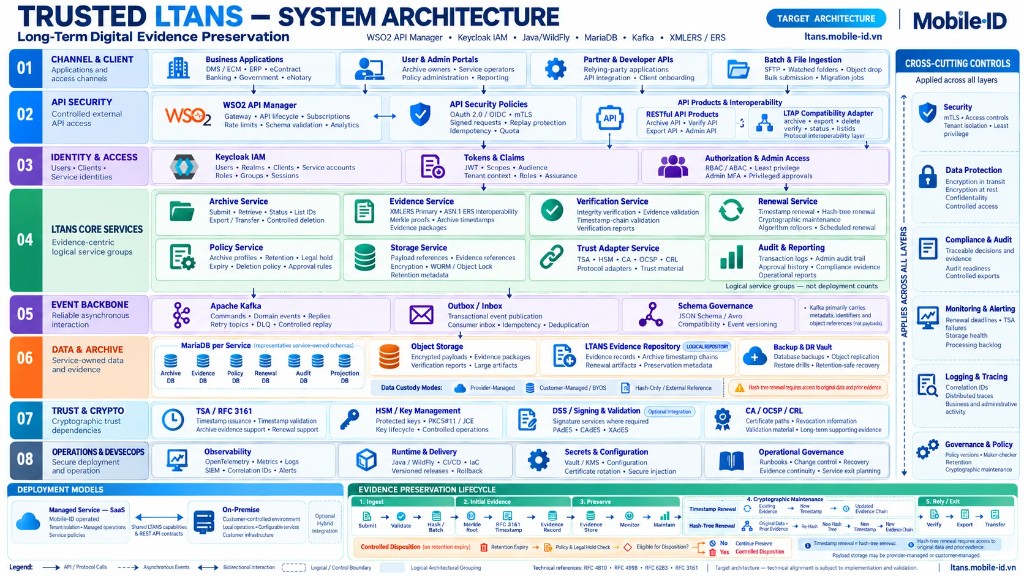
| Situation | Target design rule | Acceptance method |
|---|---|---|
| Metadata committed, outbox undelivered | Use local transaction/outbox reconciliation; no duplicate intake. | Inject failure after commit/before send, recover and count effects. |
| Bytes present, metadata incomplete | Quarantine unbound objects; garbage collection considers retention/custodian. | Reconcile inventory against intake, without blind deletion. |
| Evidence persisted, projection late | Owner record is authoritative; dashboards expose lag. | Rebuild projection without altering evidence revisions. |
| Lost key, retained ciphertext | Byte recovery and decryption authority are separate gates. | Exercise exact-byte retrieval and verification after authorized key recovery. |
Keycloak issues tokens/identity rather than executing archive work on every request. Nine service groups include Webhook Delivery; adapter/infrastructure do not change the group count. Deployment determines topology.